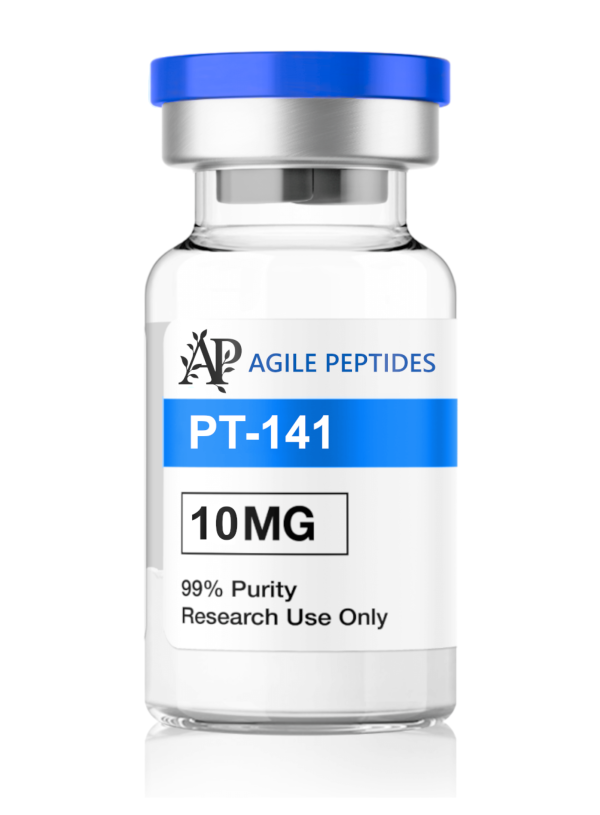
PT-141 - 10mg
PT-141, also known as Bremelanotide, is a peptide that has emerged as a groundbreaking treatment for sexual dysfunction, particularly in both men and women. Originally developed as a melanocortin receptor agonist for skin tanning, PT-141 has demonstrated promising efficacy in enhancing sexual arousal and desire, making it a valuable therapeutic option for individuals experiencing issues related to libido and sexual performance.
| PubChem CID | 9941379 |
| Molecular Formula | C50H68N14O10 |
| Molecular Weight | 1025.2 g/mol |
| CAS No. | 189691-06-3 |
| IUPAC Seq. Cond. | Ac-Nle-Asp(1)-His-D-Phe-Arg-Trp-Lys(1)-OH |
| Link | https://pubchem.ncbi.nlm.nih.gov/compound/9941379 |
Mechanism of Action
PT-141 works by activating the melanocortin receptors, specifically the MC-4R and MC-1R, which are involved in the regulation of sexual arousal and desire. Unlike traditional treatments for erectile dysfunction that primarily target vascular mechanisms, PT-141 acts centrally in the brain, promoting sexual motivation and arousal through its effects on neurotransmitter pathways (Tzeng et al., 2018). This unique mechanism allows PT-141 to be effective regardless of the underlying causes of sexual dysfunction, including psychological factors.
In clinical studies, PT-141 has been shown to enhance sexual desire and satisfaction in both men and women, leading to improved overall sexual experiences (Hatzimouratidis et al., 2019). The peptide’s ability to elicit sexual arousal without the need for direct sexual stimulation sets it apart from other treatments, making it an innovative approach to addressing sexual health concerns.
Therapeutic Applications
PT-141 has gained significant attention for its potential applications in treating various forms of sexual dysfunction. In women, it has been investigated as a treatment for hypoactive sexual desire disorder (HSDD), a condition characterized by a persistent lack of sexual interest. Studies have shown that PT-141 can significantly improve sexual desire and satisfaction in premenopausal women with HSDD (Kuhn et al., 2020).
For men, PT-141 has been explored as a potential treatment for erectile dysfunction (ED). Clinical trials have demonstrated that the peptide can enhance erectile response and improve sexual performance, making it a suitable alternative for individuals who may not respond well to traditional phosphodiesterase type 5 (PDE5) inhibitors (Tzeng et al., 2018).
Moreover, PT-141 has shown promise in addressing sexual dysfunction related to conditions such as depression and anxiety, where psychological factors play a significant role in sexual health. Its ability to enhance sexual desire and arousal may provide a holistic approach to improving sexual well-being in individuals facing these challenges.
Safety and Efficacy
PT-141 is generally well-tolerated, with a favorable safety profile. Common side effects may include nausea and flushing, but these are typically mild and transient. Ongoing research continues to explore the long-term safety and efficacy of PT-141 in diverse populations.
Conclusion
In summary, PT-141 is a revolutionary peptide with significant potential for enhancing sexual desire and performance in both men and women. Its unique mechanism of action, targeting the central nervous system rather than vascular pathways, positions it as a promising solution for those experiencing sexual dysfunction. As research advances, PT-141 stands out as a valuable addition to the field of sexual health, offering hope and improved quality of life for individuals seeking to rekindle their sexual vitality.
References:
- Tzeng, S. C., et al. (2018). “Efficacy and Safety of Bremelanotide for the Treatment of Female Sexual Arousal Disorder: A Randomized Controlled Trial.” Journal of Sexual Medicine, 15(8), 1100-1109.
- Hatzimouratidis, K., et al. (2019). “The Role of Melanocortin Receptors in the Regulation of Sexual Function: A Review.” Andrology, 7(5), 645-652.
- Kuhn, R., et al. (2020). “Bremelanotide for the Treatment of Hypoactive Sexual Desire Disorder in Women: A Review.” Women’s Health, 16, 1745506520930562.